
Unpacking the global potential for packaging automation solutions, 2024-2035.
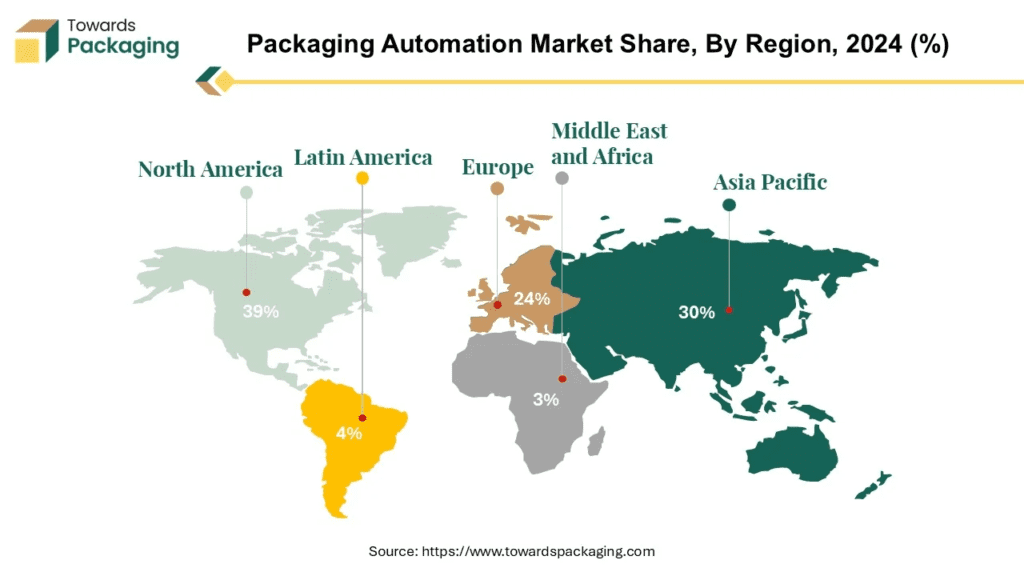
Why Packaging Automation Is Growing Rapidly
Packaging automation is being adopted across industries due to a combination of labor challenges, throughput demands, and consistency requirements.
Key forces driving adoption include:
- Labor shortages in repetitive packaging roles
- Rising demand for higher production speeds
- Increased focus on workplace safety and ergonomics
- Greater product variation requiring flexible automation
- Growth in e-commerce and short production runs
As a result, manufacturers are moving away from fully manual packaging toward semi-automated and fully automated cells.
What “Packaging Automation” Actually Includes
Packaging automation is not a single technology. It typically spans multiple stages of a production line, including:
- Case packing and carton loading
- Palletizing and depalletizing
- Pick-and-place operations
- End-of-line inspection and labeling
- Conveyance and product flow control
Robotics plays a central role, but systems often combine:
- Robots (cartesian, SCARA, delta, articulated)
- Conveyors and material handling
- Sensors, vision systems, and safety devices
- PLC or robot-based control platforms
Market Direction and Industry Outlook
Industry research indicates that packaging automation is expected to continue growing steadily through the next decade, with especially strong adoption in:
- Food and beverage
- Consumer packaged goods (CPG)
- Pharmaceuticals and medical devices
- Logistics and distribution
Emerging trends shaping future systems include:
- Collaborative robotics for flexible packaging tasks
- Modular automation cells that can be redeployed
- Smaller-footprint palletizing systems
- Increased use of simulation and offline programming
- Greater emphasis on energy efficiency and sustainability
Rather than large, fixed automation lines, many facilities are shifting toward scalable, adaptable packaging solutions.
Automation Challenges in Packaging Environments
While adoption is accelerating, packaging automation presents unique challenges:
- High product variation (sizes, weights, SKUs)
- Frequent changeovers
- Tight floor-space constraints
- Washdown or cleanroom requirements
- Integration with legacy equipment
Successful implementations focus on flexibility first, not just cycle time.
How This Knowledge Center Uses Industry Research
This article is designed to give readers context and understanding, not to replace full market research reports.
If you’re interested in:
- Market sizing
- Regional growth data
- Revenue forecasts
- Investment trends
You should reference the full report linked below.
Source & Further Reading
This overview was informed by publicly available industry research, including the following report:
Packaging Automation Market Sizing & Insights
Toward Packaging
🔗 https://www.towardspackaging.com/insights/packaging-automation-market-sizing
All credit for detailed market analysis and projections belongs to the original authors.